
The $600K question: should your charity own its fundraising platform?
· 7 min read
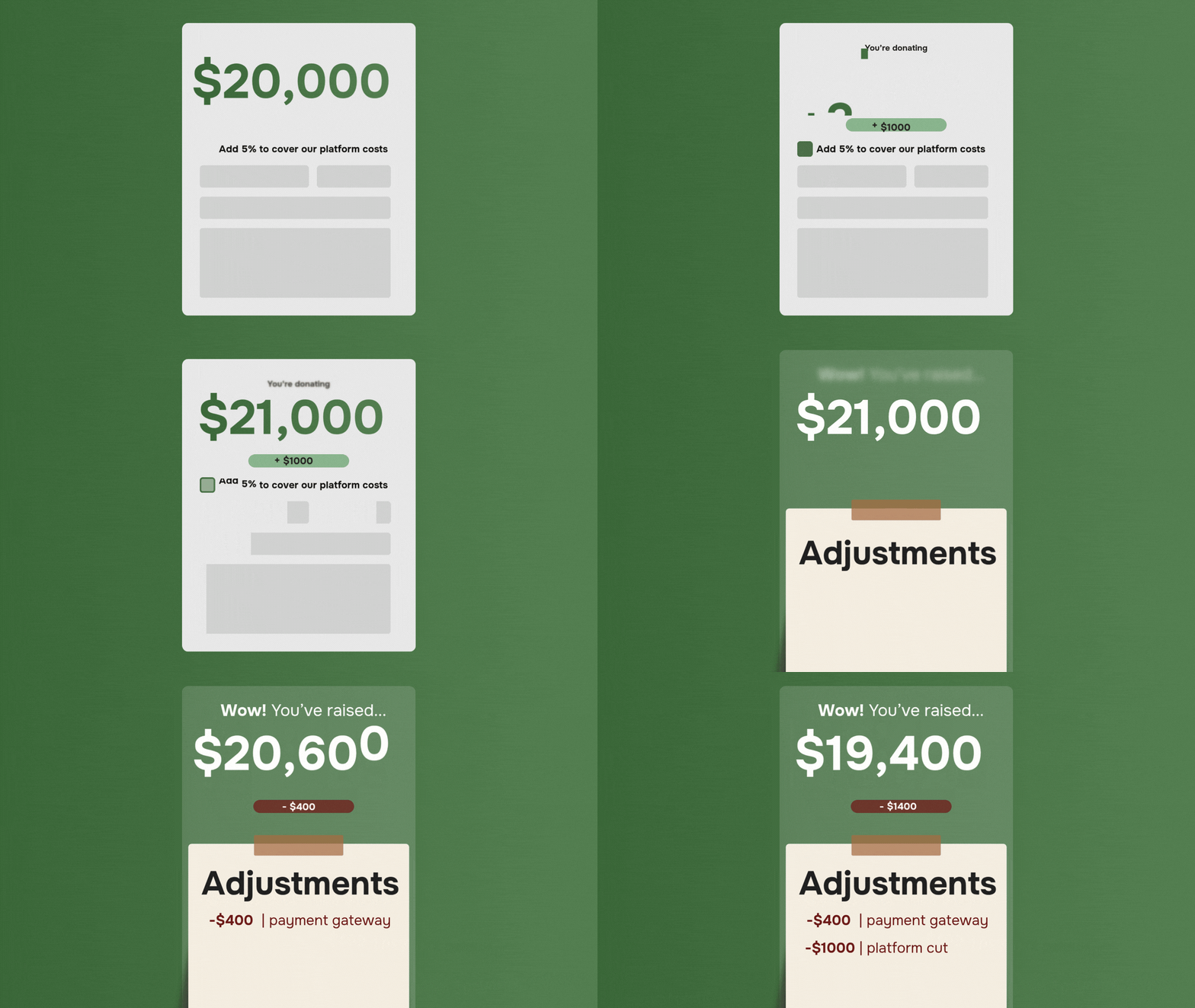
If your organisation runs its online giving through Raisely, Funraisin or GoFundraise, there's a fair chance your donors are being asked to add a few percent at checkout to "cover platform costs". It feels free. But every one of those dollars is supporter goodwill going towards your platform, instead of your cause.
That doesn't automatically mean you should ditch it. For lots of charities, renting a platform is the right call, and I'll say so plainly below.
This guide is for the person who's been quietly wondering whether your organisation has outgrown it. We'll walk through what renting actually costs, roughly where owning starts to pay for itself, the honest risks of building, and the questions worth asking before you take anything to your board.
Quick bit of context: I'm Isaac, and I run Transform Creative, an Adelaide creative agency that helps not-for-profit organisations save money by building custom platforms that allow you to keep more of what donors give.
So yes, we build these. Which is why I'd rather be upfront about when you shouldn't.
What renting actually costs
Most of the big Aussie platforms get paid one of two ways: a percentage taken from each donation, or a "tip" your donors are prompted to add on top. Here's roughly how the main ones work.
- Raisely is free to use, funded by an optional donor tip. If you switch the tip off, it charges a flat 4% (plus tax) on transactions, (unless you qualify for enterprise pricing).
- GoFundraise runs an optional contribution by default, or a service fee of 0–6% + GST depending on your licence and fee model. Regular giving sits at 1.95% + GST.
- Funraisin is quote-based, usually a setup fee plus monthly hosting. Depending on how your site's configured, donors may also see a "cover platform costs" prompt.
Card processing (Stripe or PayPal) sits on top of all of these. You'd pay that on a custom platform too, so I'll leave it out of the maths.
As you probably know, most donors leave the tip box ticked, even when it's set above 5%. So whichever way your organisation is set up, it's often somewhere around 4–5% of online giving going to your fundraising platform each year. (If on by default, your donors pay it; if off by default, you do).
It might not hit your books, but you're still missing out
This is the bit I think catches a lot of orgs out. On Raisely, for example, the tip runs through your Stripe account and gets passed to the platform before your payout lands. Depending on how your bookkeeper reconciles that, it might never show up in your accounts as revenue or as a cost.
If that's the case for your organisation, your cost-to-raise looks better on paper than it really is. Your supporters handed over more than your books record, and the difference went to software your organisation doesn't own.
So should I build my own platform?
In our experience, owning your platform usually starts paying for itself somewhere around $600K a year in online donations. That's giving through the platform, not your organisation's total revenue.
Why that number? Our builds usually land around $10–20K upfront, then $15–70K a year to host, maintain and keep improving, depending on how big and complex the site is. At $600K online, roughly 4% going to the platform is about $24K a year, which is about where those lines cross.
| Online donations a year | ~4% going to your platform each year | Over three years |
| $300K | $12K | $36K |
| $600K | $24K | $72K |
| $1M | $40K | $120K |
| $2M | $80K | $240K |
When we moved Ping Pong-a-thon onto their own custom platform, their donation income went up by about 4%. That's the figure I'd plan around, rather than the full tip.
Your numbers will depend on your tip setting, how many donors tick it, and how much flows through regular giving. The savings calculator on our site runs this for your own figures.
When renting is the right call
If any of these sound like your organisation, I'd suggest staying where you are for now.
- You're raising less than about $600K a year online. The platform's cut is real, but a custom build probably won't pay for itself yet.
- You run one or two campaigns a year and the off-the-shelf templates do the job.
- You need something live in a fortnight. Rented platforms are quick to spin up, and a custom build takes longer.
- You're mid-way through your busiest season. Please don't change platforms the month before your flagship event.
These platforms exist for good reason. For a smaller charity, no upfront cost and no monthly bill is a pretty good deal, and a tip is a fair way to fund that.
What owning gets you besides lower fees
Fees are usually what starts the conversation. In my experience, they're often not the main reason organisations end up glad they moved.
- Your donor data, in one place you control. The average not-for-profit keeps supporter info across three separate platforms (Infoxchange, 2025). Owning yours means you can see who gave, how often, and what brought them back.
- Reporting your board and funders want. Data and reporting is now the sector's top tech priority, yet only 20% of not-for-profits fully agree their systems help them understand their impact. A platform built around your program can track the things you already report on.
- Built around how your organisation fundraises. Your event format, your registration flow and your team structure, without squeezing them into someone else's template.
- A fixed, predictable cost. A percentage grows as your campaigns grow, so a fixed fee means a great year doesn't cost you more.
- Someone else to run it. Nearly half of not-for-profit websites are looked after by a staff member with limited tech skills, and finding affordable, skilled tech help is now the sector's second-biggest challenge. Whoever builds yours should host it, maintain it and pick up the phone on event weekend, in your timezone.
The honest risks of building
Owning your platform isn't risk-free, and I'd be wary of anyone who says it is. We're selling something too, so here's the list I'd want in your shoes, with the question I'd put to any builder (us included).
| The risk | What to ask |
| Your biggest weekend is the worst time to find out the site can't cope | Has it been tested under real event load, and who's on call that weekend? |
| Being stuck with one supplier | Are the code and the data yours? Could another developer pick it up if you part ways? |
| Moving your monthly donors | Whose Stripe account holds the card details today? Raisely, for example, processes through your own Stripe account, which usually makes a move far easier. PayPal recurring can be trickier. |
| Losing features you rely on | Which of today's features do you actually use, and will each one be there on launch day? |
| The cost that never ends | What's in the yearly fee? Hosting, security updates, support, new features? |
If a builder can't answer those clearly, I'd keep looking. And if your own team can't answer the Stripe question, that's a good one to check this week, whatever you decide.
Three ways forward
- Stay put. If you're under about $600K online, or heading into your busiest season, this is usually the right call. It might be worth rewording the tip prompt so donors know exactly where it goes.
- Negotiate. If you're well above the crossover, ask your platform about enterprise pricing. Some offer custom fees for larger organisations, and it costs you nothing to ask.
- Own it. If the fees are real money and you're carrying other pain (data you can't get at, reporting that takes days, features you keep fighting for), get a proper quote. Then put both numbers side by side for your board, over three years.
Where does your organisation sit?
Hear me out… what would change for your organisation if that 4–5% went towards your cause, instead of your platform?
If you're not sure which side of the line you're on, start with your own numbers. Pop them into the savings calculator and it'll show roughly what's going to your platform each year.
If the number's bigger than you expected, I'd love to have a (no-pressure) chat. We're in Adelaide, we pick up the phone, and if custom isn't right for your organisation yet, we'll tell you.
- custom fundraising platform
- not-for-profit fundraising
- raisley